Best Over-the-Door Organizers for Renters (No Drilling Required)
Can you use an over-the-door organizer without drilling?
Yes — most over-the-door organizers are built to hook over the top edge of a standard hinged door and need zero screws, anchors or wall damage. The catch is that “fits most doors” on the packaging is doing a lot of work: every hook, basket rack and pocket organizer has a maximum door thickness and a weight limit, and if your rental’s hollow-core door falls outside either number, the unit either won’t close flush or it’ll bend the door’s thin veneer over time.
The numbers below aren’t marketing copy — we opened each product page and pulled the door-thickness and weight specs directly, because that’s the one thing most “best over-the-door organizer” lists skip. A few unsourced estimates (install time) are editorial judgment calls based on the install method described on each product page, not numbers we measured ourselves — we’ll flag that once here instead of repeating it in every section.
What to check before buying: door type, thickness and weight limits
Three things determine whether an over-the-door organizer will actually work on your door, and all three are worth checking before you order anything.
1. Door type. Over-the-door organizers need a hinged door with a continuous, unbroken top edge. Standard interior and closet doors work. Bifold and accordion closet doors are a poor match: the panels fold face-to-face and the top rail is usually taken up by the pivot pin and track hardware, so there’s nowhere for a hook to sit and nothing to stop the organizer from getting crushed in the fold.
2. Door thickness. This is the number manufacturers bury in the specs. Standard interior doors in the US are 1-3/8" (1.375") thick, while exterior doors run thicker at 1-3/4" (1.75") — and that half-inch difference matters because many hooks top out at 1½" (vk-hardware.ca). Measure your door with a tape measure before buying rather than assuming “standard.”
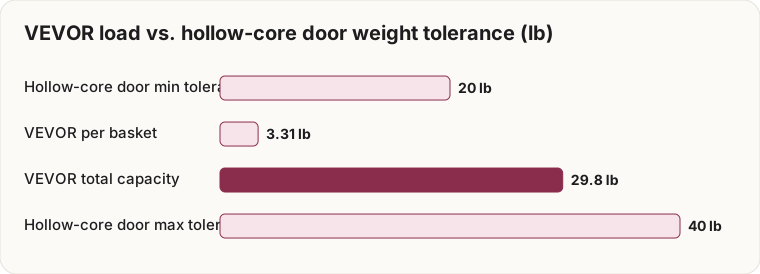
3. Weight limit — and the door, not just the hook. A hook’s stated capacity assumes the door itself can take the load. Hollow-core doors — the thin, honeycomb-cored slabs common in rentals — can generally handle roughly 20–40 lbs of hanging weight total before the hardware starts pulling at the thin face veneer, regardless of what any single hook is rated for (House Digest). Useful news: hollow-core and solid-core doors are built to the identical 1-3/8" thickness, so hardware fit is the same either way — it’s only the weight tolerance that differs (vk-hardware.ca).
If you’re furnishing a whole small apartment and this is one of several storage problems you’re solving, our guide on where to store Christmas decorations in a small apartment covers the same no-drill, rental-friendly thinking for seasonal bins.
Over-the-door organizers compared
| Product | Best for | Max door thickness | Weight capacity | Install method | Price |
|---|---|---|---|---|---|
| VEVOR 9-Tier Pantry Organizer | Kitchen/pantry doors | 2" | 29.8 lb total / 3.31 lb per basket | Hangs over door, no drilling; optional wall screws | $37.90 |
| IKEA BÄRFIS Adjustable Hanger | Closets, bedrooms | <1½" | 9 lb per hook | Hangs from top edge only | $29.99 |
| IKEA TJUSIG Wall/Door Rack | Closets, entryways | 1⅝" | Not stated | Over-door fixtures (no drill) or wall screws (drill) | $14.99 |
| IKEA ENUDDEN Hanger | Small bathrooms | 1½" | Not stated | Hangs over door, no drilling | $9.99 |
| IKEA SKOGSVIKEN Hook (2-pack) | Budget / thin doors | ¾"–1⅝" (reversible ends) | Not stated | Hangs over door edge, no drilling | $2.99 |
Specs confirmed on each manufacturer’s product page — see the Sources section below.
Best for pantry and kitchen doors
The VEVOR 9-Tier Over the Door Pantry Organizer is built for the job: it fits doors up to 2" thick, which covers both standard 1-3/8" interior doors and the slightly thicker pantry or kitchen doors some rentals use. It carries a total capacity of 29.8 lb spread across nine baskets (six small, three large), with each basket individually rated for 3.31 lb — enough for spice jars, snack bags and sauce packets without overloading any single shelf. One detail worth noting from the spec page: it needs a door gap greater than 0.06" (1.5mm) and at least 7.1" of clearance behind the door to swing open fully, so measure your pantry door’s swing room before ordering. No drilling is required for the over-door hang; VEVOR includes screws only as an optional alternative for permanent wall mounting.
Best for closets and bedrooms
For coats, bags and robes in a bedroom closet, IKEA’s BÄRFIS adjustable hanger is the most flexible option we found: it extends from 29½" to 39⅜" wide, so it can span a wider closet door, and hangs from the top edge only — no face-mounting, no drilling. The tradeoff is a modest 9 lb max load per hook, so it’s suited to clothing and bags rather than heavy items. It fits doors under 1½" thick, which covers standard interior doors but not thicker solid exterior-style doors.
If you want multiple hook positions instead of hanging bars, IKEA’s TJUSIG wall/door rack fits doors up to 1⅝" thick and ships with two fixtures specifically for over-door mounting — no drilling needed for that configuration. It can also be wall-mounted with screws if you ever move somewhere you’re allowed to drill, which makes it a slightly more future-proof pick than hooks designed only for over-the-door use.
Best for small bathrooms
Bathroom doors are often the thinnest, lightest hollow-core doors in a rental, and space behind them is tight, so bulk matters. IKEA’s ENUDDEN hanger is a compact option at 13¾" wide and just over 5" tall, with six hooks for towels and robes, a covered back designed to avoid scratching the door, and compatibility with doors up to 1½" thick. It hangs over the door with no drilling required for that mounting option.
Best budget pick
For under $3, IKEA’s SKOGSVIKEN hook (sold as a 2-pack) is the cheapest verified option here. Its reversible design has one end for thinner doors (down to ¾") and the other for doors up to 1⅝" thick, which makes it one of the few products in this comparison explicitly built to handle unusually thin doors — useful for older interior doors or cheap bifold-style closet doors that are thinner than standard. It hangs over the door edge with no drilling and no tools.
How to install an over-the-door organizer step by step
- Measure your door’s thickness with a tape measure at the edge, not just a guess based on “standard.” Compare it to the product’s stated maximum.
- Check door swing clearance. Confirm the organizer’s depth won’t hit a wall, cabinet or other door when yours opens fully — this is the VEVOR’s specific requirement, but it applies to any basket-style unit.
- Hang the hook assembly over the top edge of the door on the side that opens away from you, so the weight pulls the organizer against the door rather than away from it.
- Test the door swing empty first. Open and close the door a few times before loading anything, to confirm the hinges still clear the frame and the latch still catches.
- Load from the bottom up for basket or pocket-style organizers, so the heaviest items sit lowest and don’t tip the unit forward.
- Recheck fit after a week. Door hardware can settle slightly once weight is added; a quick check avoids a surprise later.
Common mistakes that damage doors or cause organizers to fall
- Guessing door thickness instead of measuring it. A rack rated for 1½" that’s forced onto a 1¾" exterior-style door won’t let the door latch properly.
- Overloading one side of a basket organizer, which can tip the whole unit forward and strain the hooks at the top.
- Using a full-weight pantry organizer on a bifold or accordion closet door. These doors fold on themselves and usually don’t have a continuous top edge for a hook to sit on.
- Ignoring the door’s own weight tolerance, not just the organizer’s hook rating — a hollow-core door can only take so much hanging weight regardless of what the hardware says (House Digest).
- Slamming the door repeatedly once loaded. Repeated impact can work hooks loose over time even within the rated weight limit.
FAQ
Will an over-the-door organizer damage a rental’s hollow-core door? Not if you stay within the door’s weight tolerance (roughly 20–40 lb total for a typical hollow-core interior door) and use a hook-over-the-top design rather than anything that requires screwing into the door face (House Digest).
What’s the standard door thickness I should check against? Interior doors are typically 1-3/8" thick; exterior doors are 1-3/4" (vk-hardware.ca). Measure yours — older or custom doors can vary.
Can I use an over-the-door organizer on a closet with bifold or sliding doors? Generally no. Bifold doors fold face-to-face and often lack a clear top edge for a hook, and sliding closet doors don’t have an edge to hang over at all. A wall-mounted or over-the-rod option is a better fit for those.
Do heavier pantry organizers need wall screws instead of hanging over the door? Not necessarily — the VEVOR 9-Tier model, for example, is designed to hang over the door with no drilling, and includes wall-mount screws only as an optional alternative if you prefer a permanent install.
Is a cheap $3 hook actually strong enough for everyday use? For light items like towels, scarves or tote bags, yes — IKEA’s SKOGSVIKEN hook is rated for thin-to-standard door thicknesses and is a reasonable budget pick, though none of the sources we checked published a numeric weight limit for it, so keep loads light and avoid hanging anything bulky or breakable.
Sources:
- Standard Door Thickness Guide — VK Hardware
- The Best Way To Hang Things On A Hollow Core Door — House Digest
- ENUDDEN Hanger for door, white — IKEA
- BÄRFIS Hanger for door, adjustable — IKEA
- TJUSIG Wall/door rack with knobs, black — IKEA
- SKOGSVIKEN Hook for door, black — IKEA
- VEVOR 9-Tier Over the Door Pantry Organizer